The advice says trust your team and delegate more. Here's why that rarely sticks on its own, and what tends to work better.
If you've ever promised yourself you'd give someone room to run with a project, then found yourself messaging them for an update by the end of the same day, you already know the loop.
You hand over the work with the best intentions. A day goes quiet, you start wondering whether it's on track or quietly going sideways, and before long you've asked for a status. The reply comes back reassuring, you feel a flicker of relief but also a little guilt for having asked, and within a week you're checking in twice a day again. The resolution to step back has expired, and you're not quite sure when it happened.
If that's familiar, you've almost certainly run into the standard advice for breaking out of it: delegate more, trust your team, hold fewer check-ins, stop hovering. It makes sense.
But micromanagement is a tricky habit to break, so it's worth understanding why you're stuck in the cycle and how you can change it. The short answer is that micromanaging is often less about trust than about visibility, about what you and your team can and can't see.
What causes micromanagement?
Most of what's written about micromanagement treats it as a character problem. The familiar version is that micromanagers are insecure, struggle to trust their teams, or need to feel in control.
A 2025 systematic review of the micromanagement literature found that a manager's low trust in their people is the reason most commonly given for why they do it.
But trust can be built in many different ways, including visibility.
So whether micromanagement is caused by personality, culture or pressure, making performance visible to everyone creates an opportunity for trust in both directions. Let's look at that.
Why micromanagement is often a visibility problem
Think about why you check in. For most managers, most of the time, it isn't for the pleasure of it, and it isn't because you've decided your team can't be trusted. You check in because you don't see the full picture, and this sits badly when you're the one accountable for the outcome. The check-in is a way to close that gap.
Looked at this way, a good deal of everyday micromanagement is less of a floor and more like a workaround. When the only way to find out how things are going is to ask someone, asking becomes the system. The status meeting, the quick catch-up, the message that opens with "how's it going with," all of them exist to move information from the people who have it to the person who needs it. It's meant to ensure the whole team succeeds, not to bring anyone down. However, what can happens is that the manager ends up becoming a bottleneck while the team ends up feeling watched.
It's also why deciding to trust more frequently doesn't hold. You can resolve to trust your team completely and still have no way of seeing whether the queue is backing up, whether a rep is drifting off target, or whether the urgent ticket that came in an hour ago was ever picked up. The resolve doesn't lower the uncertainty, so the moment things go quiet, the urge to check in comes straight back.
If a fair share of micromanagement is a response to not being able to see, then it's less about becoming a different kind of manager and more about making those check-ins less required. This is something anyone can change.
What happens when the whole team can see the same data?
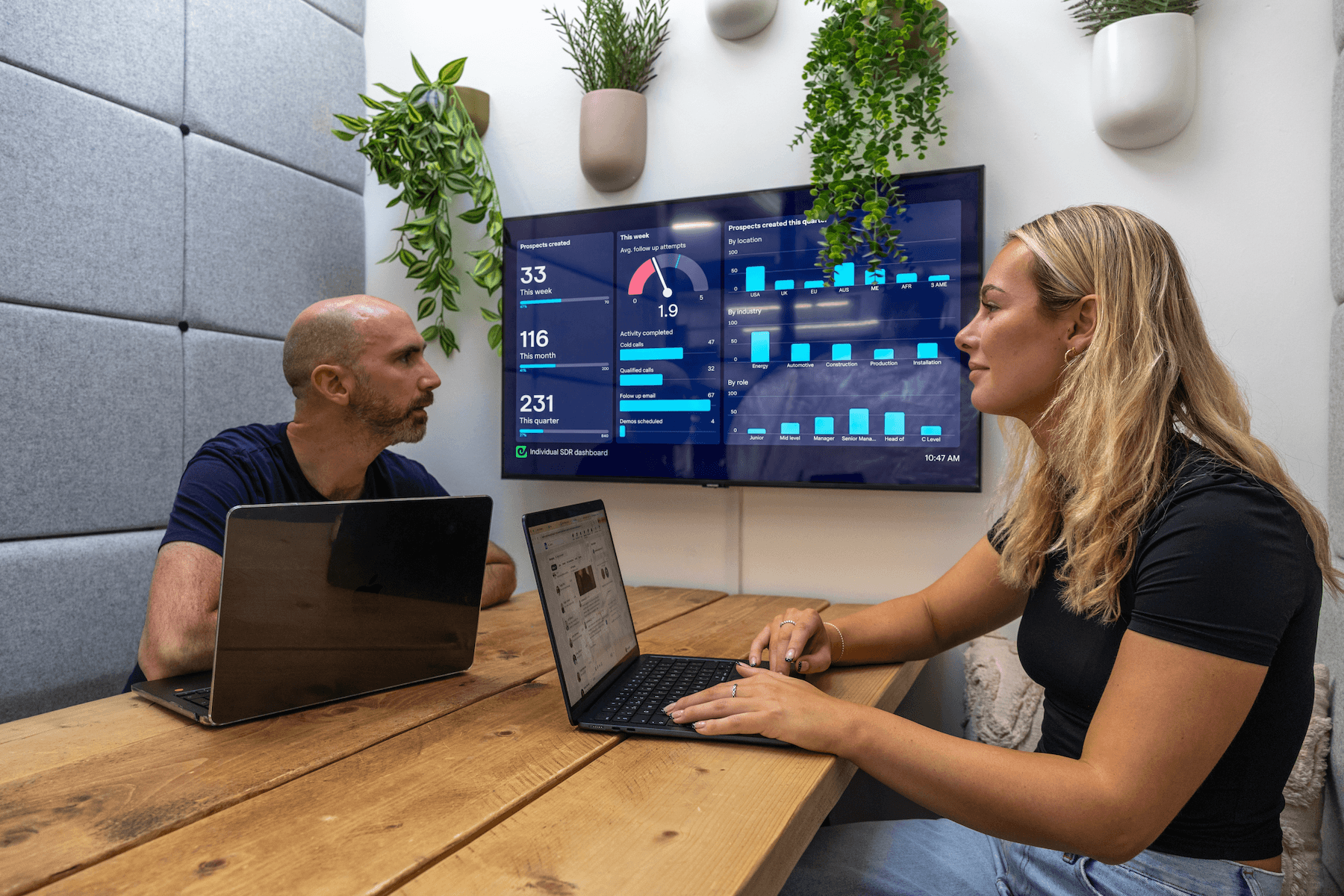
Patricia Limb, Head of Customer Experience at Selective Marketplace, ran a contact center where that gap was costing time. Agents couldn't see how they were doing without asking, and she couldn't see how the floor was performing without checking. So she put the team's live performance on a TV dashboard, visible to everyone, built from the data they already had.
Once her agents could see what she could see, many of them started adjusting without being asked.
The dashboard creates transparency for the team and autonomy for the agents. It helps them to figure things out by themselves, removes unnecessary communication and avoids micromanagement. Patricia Limb, Head of Customer Experience, Selective Marketplace
Following the introduction of the dashboard, the team reached 100% CSAT. Patricia got there by changing what the team could see, and their behavior changed as a result.
An agent who can watch the queue building doesn't need to be told to pick up the pace. Someone who can see their own resolution numbers slipping gets the chance to act before a manager points it out.
You're naturally building a more data driven culture too, so the data becomes something everyone in the office is aware of regardless of their role. Here's Kelli Grinter, COO of MTD Training:
People are used to checking the dashboards while making a cup of tea. You hear conversations across the office about what is happening and how they can help.
No one told Kelli's team to check the numbers on the way to the kitchen. They do it because the information is there and it's theirs. Once a team can see the full picture, the ownership and accountability of the team follows.
What do managers gain by stepping back?
It'll take a bit of getting used to for you and the team.
For a lot of managers, often the daily check-ins are the part of the job that feels most like you're managing. Chasing updates, building the weekly report, being the person who knows the status of everything, it all feels productive, so handing it to a shared screen can feel at first like doing less.
What you get back is considerable. The hours that went into gathering and relaying information are suddenly yours again, along with the energy that went with them.
You also get a shot at building the kind of team most managers say they want. Paul Zak's research in Harvard Business Review found that people in high-trust workplaces report 50% higher productivity, 76% more engagement, and 40% less burnout than those in low-trust ones, and his own conclusion is that high-trust companies hold people to account without micromanaging them.
Shared visibility is one of the more practical routes there, because it lets you step back without flying blind. You're not choosing between knowing what's going on and trusting your team, you can have both.
The onus goes from changing who you are as a person and puts emphasis on the information available to everyone. You're changing how information is shared in your team, then giving people a little room to act on what they can now see.
Some team members can feel a little reluctant to have their performance data out in a public space, but once they realize that it gives them the freedom to manage their own work in a way that hasn't been possible before, the results can be astounding.
How to stop micromanaging: where to start
You don't need to overhaul your reporting. Pick the handful of numbers your team is measured on, the queue, the targets, the satisfaction scores, whatever KPIs they’re measured against, and put them somewhere everyone can see, updating in real time rather than in a report that lands once a week.
Geckoboard does this by pulling live data from the systems you already use and showing it on a shared dashboard, so the whole team is looking at the same picture.
Then pay attention to your own urge to check in. When the answer to "how are we doing" is already on the wall, the question stops being worth asking, and that's the point where you can move from managing the work to developing the people doing it.
Frequently asked questions
Is micromanagement always a sign of insecurity or lack of trust? Not always. Low trust in the team is the reason most commonly cited in the research, and for some managers it's the real one. For many others, though, micromanagement is a response to poor visibility: when you can't see how the work is going, checking in feels like the only way to know.
How do I stop micromanaging without losing track of what's happening? Give the whole team a shared, live view of the numbers they're measured on. When everyone sees the same real-time picture, people tend to self-correct without being prompted, and you stay informed without chasing updates. You get oversight and autonomy at the same time, rather than trading one for the other.
Does micromanagement reduce productivity? The evidence points that way. Paul Zak's research in Harvard Business Review found that people in high-trust workplaces, where managers hold people to account without micromanaging, report 50% higher productivity, 76% more engagement, and 40% less burnout than those in low-trust ones.
What's the difference between micromanaging and staying informed? Staying informed means having ready access to the information you need. Micromanaging tends to mean extracting that information through repeated check-ins because there's no shared source for it. A shared dashboard turns the second situation into the first.
