
Octopus Legacy helps people plan for death and supports families after a loss, making difficult moments a little easier to manage.
Its services include wills, trusts, lasting powers of attorney, probate, and more holistic planning support. Being available when customers need help is central to the experience it wants to provide.
“We believe we should have no missed calls. There is never an excuse for a customer not getting through.”
Maintaining that standard became more complex as Octopus Legacy grew from seven people to around 170 in just a few years.
Calls, emails, leads, and other customer interactions were spread across Aircall, HubSpot, and Front. Teams were working hard across each platform, but they didn’t have one live view of what was happening across the operation.
For Operations Manager Hayden Gutteridge, understanding performance meant checking several tools and piecing the information together himself.
Running today’s operation with yesterday’s reports
Hayden’s role is to look across the business, find where things are slowing down, and improve the processes behind them.
Without a shared live view, he had to move between different platforms, pull the numbers together, and work from reports that described what had already happened.
“Before, it was checking here, and here, and here, then making assumptions based on yesterday’s reporting.”
That made it harder to see where customers were waiting, where calls were beginning to queue, and where the team needed more capacity at that moment.
The information existed, but Hayden was acting as the link between the data and the people who could respond to it.
Bringing live performance into one view
When Octopus Legacy acquired a company that was already using Geckoboard, Hayden saw how a shared live view could work across the wider business.
Octopus Legacy introduced dashboards bringing together the measures that mattered most from Aircall, HubSpot, and Front.
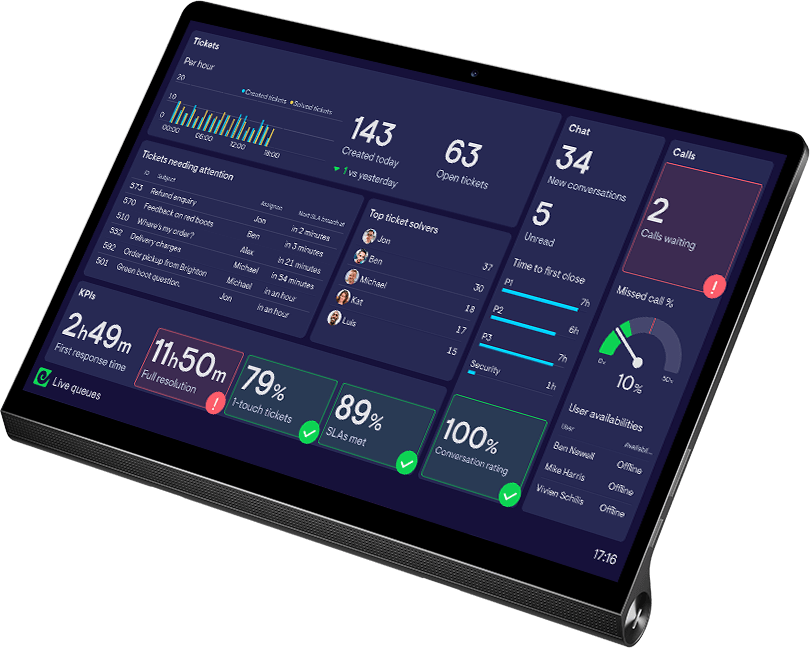
Screens around the office now show live call volumes, answer times, response times, lead flow, and sales activity. Remote teams can access the same dashboards online, so they’re working from the same information as people in the office.
Instead of waiting for Hayden to compile and distribute an update, the team can see what’s happening while there’s still time to respond.
When calls build, the team steps in
Making live performance visible changed what happened when demand increased.
If calls begin to queue, the team can see it immediately. People nudge one another and step in to help before waiting customers become missed calls.
That shared awareness has helped Octopus Legacy reduce missed calls even further and bring down its average answer time.
“We’ve always focused on minimising missed calls, but by visualising the data we were able to reduce that even further, and reduce average answer time too.”
The dashboards support the commitment to customer care that was already there. Everyone can see when customers need more attention, and the team can respond without Hayden having to flag the problem first.
Five hours a week back from manual reporting
The shift has also changed how Hayden spends his time.
He no longer has to spend part of every day pulling information from several platforms and turning it into an update for the rest of the business.
“It probably saves me an hour a day. That’s five hours a week that I’m not sitting there pulling data.”
That’s five hours he can put back into improving processes, planning capacity, and helping the business scale.
Hayden still needs to understand performance in depth, but he’s no longer the team’s only route to the numbers. The live view handles the routine updates, leaving him more time for the decisions and operational work that need his judgment.
Making faster decisions as the business grows
Bringing Aircall, HubSpot, and Front into one view helps Octopus Legacy make connections across the wider customer journey.
The team can see when more people are needed to answer calls, when capacity needs to change, or when marketing activity needs adjusting to support lead flow.
Those decisions no longer have to wait for the next report. Hayden and the team can respond to what’s happening and make several changes in quick succession when needed.
As Octopus Legacy has grown, the shared live view has helped its teams stay coordinated across different tools and locations. Everyone can see the same picture of what customers are experiencing, wherever the underlying data comes from.
Visibility reduces missed calls
Octopus Legacy has always cared about minimizing missed calls and helping people get through when they need support.
Geckoboard has made call performance visible throughout the day. The team can see calls building, step in sooner, and protect the customer experience as the company grows.
Hayden is clear about what would happen without that visibility.
“Answer times would creep up. Missed calls would rise. Out of sight really does mean out of mind.”
For Octopus Legacy, keeping performance in sight means the whole team can respond when customers need them, while Hayden gets back the time to keep improving how the operation works.
Help your support team respond sooner
Geckoboard puts live performance where agents and team leaders can see it, helping teams respond to changing demand, reduce missed calls, and stay focused on the customer.