
Selective Marketplace’s customer service agents don’t rush people off the phone.
Around 80% of their inbound calls come from customers who want to buy something, often after asking for advice about a product or sizing. Agents are encouraged to give each person the time they need, even when that means a longer conversation.
That people-first approach has helped Selective Marketplace achieve CSAT scores as high as 100%. But for a busy, call-heavy contact center, delivering that level of service across a long day takes more than good intentions. The team needs to know what’s happening as the workload changes.
Selective Marketplace is the parent company behind sustainable fashion brands Wrap London and Poetry. Patricia Limb, Head of Customer Experience, leads a team of more than 30 agents working across two shifts to support customers in the UK, Europe, and the US.

The contact center opens at 8:30 a.m. and doesn’t finish until 10:30 p.m. With calls moving between agents throughout the day, the team needed a live view of the workload so everyone could see where things were moving smoothly and where their help could make a difference.
Reports couldn’t show what was happening now
Selective Marketplace uses Zendesk Talk to manage calls and Zendesk Guide for customer service content. Patricia uses Zendesk Explore to run reports and dig into specific issues, while agents can review their weekly and monthly performance in Zendesk.
Those reports were useful for looking back, but they couldn’t help the team manage a shift as it unfolded. By the time Patricia had run a report and shared it, the workload had already moved on.
When Selective Marketplace added TV screens to the contact center, the team needed a way to make current performance visible. Zendesk’s data wasn’t timely enough for the live view they wanted, and configuring it for TV display was difficult.
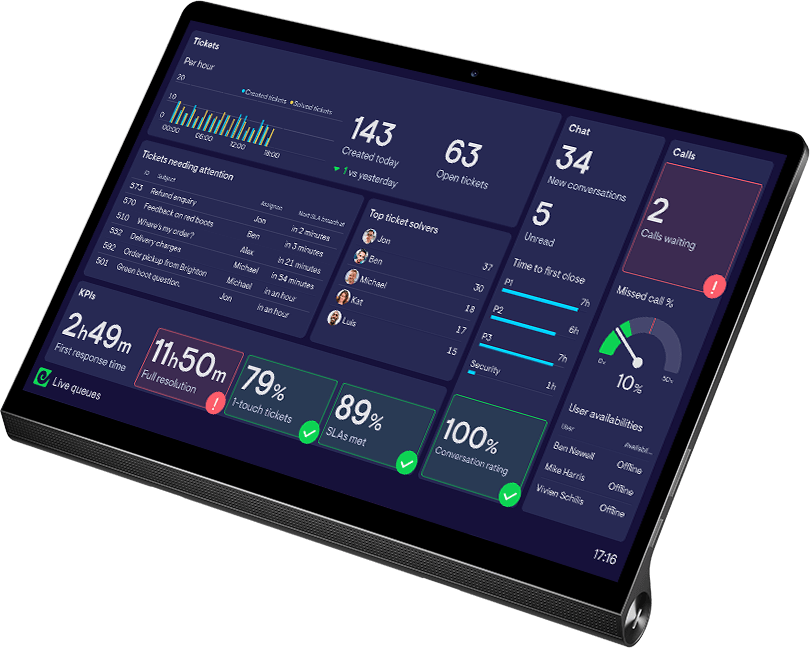
Selective Marketplace introduced four Geckoboard dashboards around the contact center, showing the current workload, CSAT, agent status, and the measures the team needs throughout the day.
Coordinating the workload as it changes
The dashboards give agents a shared view of what’s happening across the contact center.
When someone arrives for a shift, they can check the TV and immediately understand the workload. They can see who’s available, who’s already on a call, and where demand is building.
That visibility also helps the team coordinate everyday decisions. Before taking a lunch break, an agent can check whether there are enough colleagues available to handle the current call volume. When demand shifts, the team can reorganize around it without waiting for a report or an update from Patricia.
Everyone can see the same information at the same time, which makes it easier to keep work moving across two shifts and a 14-hour day.
Giving agents the confidence to act
Seeing the workload is one thing. Knowing what to do with that information is another.
Patricia’s team uses status indicators to show when performance is on or off target. The dashboards make changes clear, so agents can use their judgment and respond where they’re most needed.
“The dashboard creates transparency for the team and autonomy for the agents. It helps them to figure things out by themselves, removes unnecessary communication and avoids micromanagement.”
Agents don’t need Patricia to interpret the numbers or direct every decision. They’ve got enough context to take initiative, support their teammates, and manage more of the day themselves.
That gives Patricia and her team leaders more time to focus on coaching and the customer experience rather than passing around updates the team can now see for themselves.
Choosing measures that support good service
Selective Marketplace is careful about what it puts in front of the team.
At one point, the dashboards included the number of calls taken by each agent. Patricia noticed that people started moving through calls more quickly to reach the top of the leaderboard, and the quality of service began to fall.
“We saw the call quality drop dramatically because people were trying to get to the top, to do more work.”
The team removed that measure.
The problem wasn’t the leaderboard. It was that this particular measure encouraged the wrong behavior for a business built around personal service. Selective Marketplace chose to focus its dashboards on the measures that help agents manage the workload and give customers the time they need.
If someone’s on a long call helping a customer choose the right size, they’re not hurried off the phone. The quality of the conversation matters more than increasing the number of calls completed.
That decision reflects the flexibility of the team’s approach. They’re not displaying numbers for the sake of it. They’re choosing the information that helps agents make better decisions and deliver the experience customers expect.
Keeping people at the center of performance
Selective Marketplace consistently achieves CSAT scores between 95 and 100% and has strong staff retention within its contact center.
Live visibility supports the way the team already wants to work. Agents can see what’s happening, coordinate the workload, and take responsibility for where they can help. Patricia can focus on supporting the team and protecting the quality of the customer experience.
“That’s why we get such good feedback from our customers, because it’s just so important that they come first.”
For Selective Marketplace, putting performance where everyone can see it hasn’t meant choosing numbers over people. It’s helped a people-first team work together, respond throughout the day, and keep delivering the service its customers value.
Help your support team respond throughout the day
Geckoboard puts live support performance where agents and team leaders can see it, helping teams coordinate changing workloads, take ownership, and stay focused on the customer.